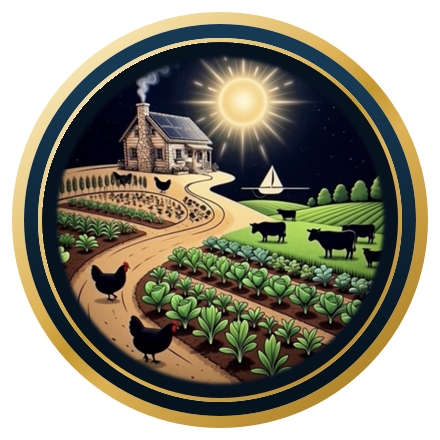
The Symbiotic Bestiary
Each animal protects or feeds something
The same land as the garden — after dark, every guardian at its post.
Bats eat the mosquitoes so I can sit outside at dusk. Bees pollinate the orchard so the apples come back every year. Geese watch the perimeter, dogs watch the geese, cats watch the granary. Nothing is decorative.
That was the dream: a piece of land where every living creature has a job, and where the work of one feeds another. The LAND Fund exists so that this dream is shared, not solitary.
— The origin of the LAND Fund
No animal in this place is here for decoration. Each one protects, feeds, fertilises, or guards something. A pet that produces nothing is welcome — but its place must be honest. The land is a contract, signed in feathers and fur.
Getting started. Start with land, care time and annual costs before choosing species.
How Much to Be Independent?
Tick and adjust to match your life — the results separate the estimated budget and annual expenses.
Assumptions: mid-range feed and hay prices from the table below, averaged over the year; the pasture switch halves the grazers' bill (geese, goats, sheep, llama, horse, donkey); the winter switch applies the ×1.25 rule; “Animals and nesting boxes” totals the one-time herd and nest boxes (mid-points of this page's own price tags) — housing and fencing are not in it (see The Roof and the Fence, below); “Feed and hay / year” is the feed and hay — the one bill that never stops, which good pasture and a mild winter shrink; the three profiles follow the Where to Begin ladder below. The drinking line reuses the Water page's mid-range values — the cistern that carries it is sized over there. A starting estimate, not a feed bill — your hay dealer, your winter and your predators will redraw it.
How Much Guard?
Compare models · How Much Guard?
| Guardian | To start | Feed / day | What it gives back |
|---|---|---|---|
| 🦇 Bats | ~$45 the bat house | $0 — it hunts | Insect predation varies with species and habitat |
| 🐝 Honeybees | ~$300 hive + colony | ~$0.20 | 20–40 kg of honey and the whole orchard pollinated |
| 🐔 Chickens | ~$25 / point-of-lay hen | ~$0.12 | 250–300 eggs a year, plus the tick patrol |
| 🦆 Runner ducks | ~$25 each | ~$0.15 | The slug line cleared, the lettuce untouched |
| 🦢 Geese | ~$45 · never fewer than three | ~$0.20, mostly grass | The loudest alarm on the land, for 20+ years |
| 🐐 Goats | ~$250 / doe | ~$1.00 | 3–4 L of milk a day and the brush cleared |
| 🐑 Sheep | ~$250 each | ~$0.90 | 2–4 kg of wool and the pasture mowed |
| 🦙 Guard llama | ~$900 | ~$1.20 | One llama covers 200 sheep; fleece $30–60/kg |
| 🐕 Guardian dogs | $600–$1,850 the trained pup · in pairs | ~$1.50 | Nights you sleep through |
| 🐈 Barn cats | Free — shelter adoption | ~$0.40 | 20–50 mice a month, each |
| 🦉 Owl nest box | ~$50 in lumber | $0 — it hunts | 3,000+ rodents a season, per family |
| 🐷 Pigs | ~$120 / piglet | ~$2.20 | Garden-ready soil and the freezer filled in 6 months |
| 🐝 Mason bees | ~$0.75 / cocoon | $0 | 200× a honeybee, per individual |
| 🦅 Falcon & hawk | $1,100–$2,600 · permit required | ~$1.20 | 1–2 km of airspace kept clear |
| 🐴 Horse | $1,800–$7,400 | ~$6.00 | Draft power, 9 t of manure a year — the page's own ~$2,200/yr |
| 🫏 Donkey | $370–$1,100 | ~$3.00, coarser forage | Predation −70–90 %, for 40–50 years |
| 🐇 Rabbits | ~$40 / doe · one buck for four | ~$0.25 | 30–40 kits a year per doe — 50 kg of meat, and manure the garden takes fresh |
| 🐦 Guinea fowl | ~$20 each · never fewer than six | ~$0.15, mostly insects | The tick patrol over the whole property, and an alarm that sees the hawk first |
| Harsh-winter rule | feed × 1.25 | — | Budget for February, not July — the hay season is the guard's real bill |
Year 1 of Where to Begin — two barn cats, a dozen hens, a bat house and the owl nest box: ≈ $395 to start and about $2.25 a day in feed — with some 3,000 eggs a year coming back. The guard pays its own wage.
What the Guard Gives Back
The table above says it in words. Here it is in numbers — a year of each, at the scale of one small sanctuary.
Compare models · What the Guard Gives Back
| Guardian | A year gives | Into the pantry | The honest note |
|---|---|---|---|
| 🐔 12 hens | ~3,000 eggs | 8 a day in June, 2–3 in December | 14 hours of light keeps them laying — a 5 W LED on a timer — or accept the winter pause |
| 🐐 1 dairy doe | ~600 L of milk | 2 L a day for 300 days | She must kid every year to give it — plan for the kids |
| 🐑 5 sheep | 10–20 kg of wool · 4–6 lambs | Lambs at 20–25 kg of meat each | Wool is worth little raw — spin it, felt it, or trade it |
| 🐷 1 pig, one season | 70–80 kg of meat | The freezer half full by November | Plus the lard — the fat the Garden can't grow |
| 🐇 2 does | 60–80 kits · ~100 kg of meat | A rabbit a week, all year | From two hutches — the most meat per square metre on the page |
| 🐝 1 hive | 20–40 kg of honey | The sugar of a household | Leave the bees 25–30 kg to cross the winter — take the surplus only |
| 🦆 6 runner ducks | 1,200–1,600 eggs | Richer than hen eggs, laid at dawn | And the slug line cleared, which is what they were hired for |
| 🐴 1 horse | ~9 t of manure | Every vegetable bed fed, and then some | The dearest guardian to keep — and the only one that pulls a sled of firewood |
What a Hectare Feeds
The calculator halves the grazers' feed when the pasture is good — but never says how much pasture. Here is the arithmetic: in zone 3–4, on decent ground and rotated through four or five paddocks, one hectare carries five to seven sheep or goats from May to October. A horse or a cow wants a hectare to itself. Overstock it and the grass is gone by August, the parasites are everywhere, and you're buying hay in the season it costs the most.
Then comes winter. A sheep eats about 2 kg of hay a day; a goat the same; a horse 10 kg. Five sheep × 2 kg × 180 days = 1.8 tonnes — some 90 small square bales, $700–900 delivered, or half a hectare of hayfield you cut and store yourself. That hay is the true price of the flock: not the $250 lamb, the seven winters of hay it will eat. Buy it in June, when it's cut, not in January, when it's scarce.
The honest ratio: a small sanctuary of two hectares — one in pasture, half in hay, half in garden, orchard and buildings — feeds a family's flock with no feed bill for the grazers. Below that, you are buying the land's work from a hay dealer, which is fine, as long as the calculator knows it.
The Manure Ledger
The Garden's compost bays want about a cubic metre a year for every 25 m² of beds. This is where it comes from.
Compare models · The Manure Ledger
| From | A year of manure | Hot or cold | How the garden takes it |
|---|---|---|---|
| 🐔 12 hens | ~500 kg | Hot — burns roots fresh | Deep litter in the coop all winter (straw over the droppings — it composts in place and warms the birds), out to the bays in April, on the beds after six months |
| 🐑 5 sheep or goats | ~2–3 t | Warm — pelleted, dry | Aged three months, or straight to the orchard as mulch |
| 🐇 2 does + kits | ~300 kg | Cold — the exception | Fresh on the beds, no waiting — the only manure on the page that allows it |
| 🐷 1 pig, one season | ~500 kg | Hot — and wet | Rooted into next year's bed by the pig itself; what's left goes to the bays |
| 🐴 1 horse | ~9 t | Warm — full of seeds | Hot-composted a year to kill the seeds it carries, then the finest bed soil there is |
| 🦆 6 ducks | ~250 kg, mostly in the water | Liquid | The pond water they foul is the richest irrigation in the garden — pump it to the beds |
The Guardians of the Land
Explore the species · The Guardians of the Land
Insect-eating bats are part of the ecosystem. Diet varies by species and habitat; putting up a bat house cannot promise a number of insects removed. The aim is to support roosts and habitat. USGS.
Source: USGS, Bat Conservation InternationalOne healthy hive produces 20–40 kg of honey per year and pollinates the entire orchard, the squash patch, and the wild flowers a kilometre around. About a third of human food depends on pollinators — bees do the bulk of the work.
Source: FAO, USDA NASSA good laying breed gives 250–300 eggs a year. Free-ranging hens scratch up grubs, eat ticks (a major Lyme vector), and till the top 5 cm of soil as they pass. Compostable manure, predator alarm, garbage disposal in one bird.
Layer breeds: Rhode Island Red, Sussex, AustralorpDucks (Indian Runner, Khaki Campbell) eat slugs, snails, and Japanese beetles without damaging vegetables — unlike chickens. Runners stay upright and don't trample greens. Best deployed in the market garden between rows of brassicas and lettuce.
Eggs: 200–280/yr (Khaki Campbell)A goose hisses louder than most dogs bark. They patrol the perimeter, alert at every shadow, and historically weeded rice and cotton fields. Embden and Toulouse breeds are big enough to deter foxes. Don't keep less than three — they need a flock.
Lifespan: 20+ yearsGoats clear brambles, poison ivy, buckthorn, and saplings the way no machine can. Boer for meat, Nubian/LaMancha for milk (3–4 L per day per doe). They need real fencing — they're escape artists — and shelter from heavy rain.
Lifespan: 12–15 yearsA flock of sheep keeps the pasture trimmed without compacting it the way cows do. Icelandic and Shetland handle USDA zone 3 winters with minimal shelter. Yield: 2–4 kg of wool per year per sheep, plus milk or meat depending on breed.
Zone 3+ hardy breedsOne guard llama placed with a flock of sheep dramatically reduces losses to coyotes, foxes, and stray dogs. They charge, kick, and stand their ground. Alpaca fleece sells for 30–60 $/kg raw — a quiet income stream.
1 guard llama per 200 sheepGreat Pyrenees, Maremma, Anatolian Shepherd, Akbash. These breeds were selected for thousands of years to live with the flock, not with humans. They sleep with the sheep, patrol at night, and confront wolves and bears. Get two — they work in pairs.
Trained pup: $600–$1,850 USDA working barn cat catches 20–50 mice per month. Mice eat your grain stores, chew electrical wires, and carry hantavirus. Two cats per outbuilding is the rule of thumb — and they keep each other company.
Working Cat adoption: free / shelterThe guardian you don't buy — you invite it. A family of barn owls eats 3,000+ rodents in a single nesting season; California vineyards and farms in Israel and Jordan mount nest boxes instead of spreading rodenticide. The barn owl lives on every continent except Antarctica; in cold climates the barred owl and great horned owl take the shift.
A wooden box mounted 3–5 m up, entrance sheltered from the prevailing winds, and the night post fills itself. It hunts while the cats sleep — look at the night view at the top of this page: it's already there.
Nest box: ~$50 in lumber · 3,000+ rodents/season per familyHeritage breeds (Tamworth, Berkshire, Large Black) root up brushy ground to garden-ready soil in weeks. Rotate them through a new bed before planting. They eat kitchen scraps, fallen fruit, and forest mast — converting waste into protein.
Finishing weight: ~6 monthsNo hive, no honey, no stings — but 200× more efficient at pollination than a honeybee, per individual. A single mason bee tube box (~30 cocoons) pollinates a small orchard. They live 6 weeks in spring, then disappear until next year.
Mason bee cocoons: ~$0.75 USD eachFalconry is one of the oldest human-animal partnerships — practised in Mongolia, Persia, and medieval Europe for over 4,000 years. The Harris's hawk is famously social and the easiest raptor to train; the red-tailed hawk and the peregrine falcon are common North American falconry birds. A trained bird patrols 1–2 km of airspace around the property: it scares off invasive starlings, hunts rodents, and is the most natural anti-pigeon system that exists.
Anti-drone capability: in 2016 the Dutch National Police trained bald eagles to intercept consumer drones (program "Guard from Above"). The French Air Force has done the same at Mont-de-Marsan since 2017 with golden eagles — the birds learn to grab a drone in mid-air and bring it back to the handler. The military uses this against quadcopters under 5 kg; on a private sanctuary, a Harris's hawk does the same on a smaller scale. Drones over a hawk's territory simply disappear.
A falconry permit is required everywhere (in Quebec: permis du Ministère de l'Environnement, de la Lutte contre les changements climatiques, de la Faune et des Parcs). Training takes 2 years of mentorship — but a trained Harris's hawk lives 20 years, recognises its handler the way a dog does, and patrols the sky every morning of its life.
Trained Harris's hawk: $1,100–$2,600 USD · permit requiredA horse is the oldest companion a piece of land can have. Beyond pleasure — daily riding, exploration of the property in places no vehicle reaches — a horse provides draft power (logging, plowing in snow, pulling a cart of firewood), compost (~9 tonnes of manure per year per horse, the gold standard for vegetable beds), and therapy: equine-assisted therapy is documented for anxiety, depression, and PTSD.
For cold climates and resilience, the Canadian Horse 🇨🇦 — "le petit cheval de fer" — was bred from stock sent by Louis XIV in 1665, became Canada's national horse breed in 2002, and tolerates zone 3 winters with a simple windbreak. The Icelandic horse 🇮🇸 and the Norwegian Fjord 🇳🇴 are equally cold-hardy and famously even-tempered.
Adult horse: $1,800–$7,400 USD · ~$2,200/year upkeepA donkey is a horse's quieter cousin with an unexpected gift: it hates canids. A guardian donkey placed in a sheep or goat pasture will charge, kick, and bite coyotes, foxes, and stray dogs — and is documented by the USDA as reducing predation by 70–90 % in small ruminant herds. One standard-sized jenny (female donkey) for up to 200 sheep.
Beyond guarding: a donkey carries 25 % of its weight as a pack animal, eats coarser forage than a horse (less feed cost), and lives 40–50 years — three generations of your goats. The Mammoth Jackstock (American breed) is the largest; the Standard donkey is the practical farm choice.
Guardian donkey: $370–$1,100 USD · 40–50 yr lifespanThe most efficient meat animal a small plot can carry: one doe raises 30–40 kits a year — around 50 kg of lean meat from a hutch the size of a desk, on hay, garden trimmings and a little grain. And their manure is the only one the garden takes fresh, no composting: cold, dry, straight to the beds.
Hardy breeds (New Zealand, Californian, Rex) winter in an unheated hutch with a windbreak and deep straw — it's the summer heat that kills them, not the cold. Keep the hutch off the ground, hardware cloth all round: the weasel and the raccoon count rabbits too.
Doe: ~$40 · one buck for four does · kits ready at 10–12 weeksThe hen eats ticks around the coop; the guinea eats them across the whole property. A flock of six ranges all day, scratching almost nothing, and comes back at dusk to roost high. In Lyme country it is the cheapest tick control that exists — and it hunts grasshoppers, Japanese beetles and small snakes on the way.
The price is the noise: a guinea screams at every stranger, every hawk shadow, every car — which is exactly the job. Never fewer than six, raised with the hens so they learn the coop, and expect them to sleep in the trees the first summer anyway. Not for a town lot.
Keet: ~$5 · adult ~$20 · 100 eggs a year, if you find the nestLayered Systems
Joel Salatin's pasture rotation, applied at the orchard scale. A movable coop of 30–50 hens cycles under the apple trees: the chickens eat the apple maggot pupae that overwinter in the soil, fertilise the trees, and lay eggs while doing it. One full orbit of the orchard per year breaks the apple maggot cycle without a single spray.
Indian Runner ducks released for an hour at dawn in a lettuce row will eat every slug and snail without touching the salad. They prefer slimy targets and walk upright between the rows. Standard practice in Japanese rice paddies (aigamo method) for over a century.
The redundant defence: the dog handles wolves and bears at night, the llama handles coyotes and stray dogs during the day, and the sheep keep grazing. Studies in Vermont and Saskatchewan show this combination reduces predation by 90–98 % compared to unguarded flocks.
The Roof and the Fence
The $395 above buys the animals. It buys them no roof. Every guardian needs a dry, dark, predator-proof place to sleep — and a line it stays behind. Put these in your number.
Compare models · The Roof and the Fence
| Shelter | How much | Roughly | The rule |
|---|---|---|---|
| 🐔 Coop, 12 hens | 4 m² inside · 12 m² of run | $300–800 built from pallets and salvage · $1,500+ bought | Hardware cloth, never chicken wire; a 30 cm apron buried outward; roosts higher than the nest boxes; a door that closes at dusk — automatic for $100 if you're not always home |
| 🦆 Duck house | 0.5 m² per bird | $100–300 | Low, dry, deep straw — ducks need a pond or a tub to dunk their heads, not to swim |
| 🐇 Hutches, 2 does + buck | 0.6 m² per adult, off the ground | $150–400 | Shade before anything: above 30 °C a rabbit dies; below −20 °C, a windbreak and straw are enough |
| 🐑 Three-sided shelter, 5 sheep or goats | 1.5–2 m² per head | $500–1,500 | Back to the prevailing wind, open to the south; goats also want a raised platform to sleep on |
| 🐴 Run-in shed, horse or donkey | 12 m² per horse | $1,500–4,000 | Hardy breeds refuse the barn — a roof and a windbreak, and a hay feeder out of the mud |
| ⚡ Electric net, poultry | 50 m rolls, movable | $200–300 per roll + $150 energiser | Moves with the chicken tractor; stops the fox and the dog, not the hawk — that's the net over the run |
| 🐐 Perimeter fence, sheep & goats | 1.2 m woven wire + one hot strand at nose height | $8–15 per metre installed | Goats test every fence once a day; if a fence holds water, it holds a goat |
| 🐝 Bear fence, the hives | Five hot strands around the apiary | $300–500 | Turn it on before the first bear, not after — a bear that has tasted a hive comes back every night |
| 💧 Water in winter | One heated bucket or trough per group | $50–150 each | 60–100 W while it freezes — about 1 kWh a day, the guard's only electric bill; count it on the Energy page |
Year 1 with a roof over it: the hens, the cats and the boxes at $395, plus a salvage coop and run at $300–800 and an electric net at $350 — call it $1,100–1,500 to start, not $395. The animals were the cheap part. They always are.
The First Night — Locking the Coop
Wolves and bears are on the Threat Map below. The flock is far more often lost to the four small ones — and to a latch.
Opens simple latches, reaches through chicken wire, pulls a hen out piece by piece. The classic morning-after scene.
🛡 Hardware cloth (1.3 cm mesh) on every opening, two-step latches or a carabiner, nothing a hand can reach through. Lock at dusk, every dusk.
Kills the whole coop in one night and eats almost nothing — the signature: many dead, little missing.
🛡 Walk the coop with a golf ball: any hole it fits through, a weasel does too. Mesh over the vents, a solid floor or a buried apron.
A red-tail takes a hen in daylight; the great horned owl takes one off the roost at night. Yes — the owl you invited for the mice.
🛡 Netting or wire over the run, roosts inside a closed house, cover the birds can dive under — and the geese and guineas, who see the shadow first.
Eat the feed, the eggs, the chicks — and bring the weasel that hunts them. A rat problem is a feed-storage problem.
🛡 Feed in metal bins with lids, nothing left in the run overnight, the cats, the owl box — and never the poison, which kills the owl and the cat too.
The dogs, the donkey and the llama on this page guard the pasture. Nothing guards a coop with a gap in it.
The Threat Map
Threats change names from one continent to the next — the answer is still an animal.
Wolf, bear, lynx, red fox, marten. The heaviest predators on the list — and a winter that starves everything that hunts.
🛡 Two livestock guardian dogs (the Pyrenees/Maremma duo), a guard donkey, the coop locked at dusk, electric fencing around the hives against bears.
Coyote, jackal, badger, daytime raptors — and not a tree to hide behind. On open ground, attacks come in broad daylight too.
🛡 Llama + dog covering day and night, alarm geese, netting over the young poultry.
Dingo, golden jackal, venomous snakes, the introduced fox (Australia's plague). Heat itself is a predator.
🛡 A guard donkey that charges canids, guinea fowl that mob and call out snakes, poultry brought into shade at midday.
Rats in the harvest, snakes, disease-carrying mosquitoes. The granary is the battlefield.
🛡 Aigamo ducks in the rice paddies, cats + barn owls at the granary, bats on mosquito duty every single night.
Puma, wolf, golden eagle taking lambs. Steep ground, scattered flocks, long nights.
🛡 The homeland of the solutions: the llama (born in the Andes) and the great mountain dogs — Great Pyrenees, Anatolian Kangal. Lambing under shelter.
Fox, stone marten (coops and cables), goshawk, wild boar in the garden — and the odd curious drone.
🛡 Geese (still the best alarm ever bred), a dog, fencing buried 30 cm deep, a Harris's hawk for the airspace.
Everywhere on Earth: rodents answer to cats and owls, slugs to ducks, mosquitoes to bats, ticks to hens — and drones to the hawk.
Breeds That Survive Zone 3–4
Developed in 1908 by Brother Wilfrid Châtelain at the Trappist abbey of Oka, Quebec — the only chicken breed entirely created in Canada. Small comb, heavy feathering, lays even at −30 °C. The original cold-climate hen.
Bred for 1,100 years in a country with no trees. Double coat (lopi wool), small body, eats lichen and shrubs. Three useful products: meat, wool, dairy. Triplets are common.
The shaggy Scottish breed. Survives outdoors all winter, eats rough forage refused by other cattle, calves easily without help. Slow-growing — perfect for a small autonomous farm that doesn't need feedlot speed.
Cashmere goats grow a winter undercoat worth 200–400 $ /kg combed. The Pygora is a Pygmy × Angora cross — hardy, smaller, easier to handle, fleece sells well to fibre artists.
Quiet (no quack), excellent mothers, lean meat, voracious fly hunters. In summer they catch flies right out of the air. Less cold-hardy than Pekins — need a windbreak in zone 3 winters.
Carniolan and Russian strains overwinter at −30 °C with proper hive insulation and a windbreak. They cluster tightly, conserve honey stores, and emerge ready for the first willow bloom. Italian bees are gentler but die more often in deep cold.
The Guardians' Year
Mason bee cocoons hatch with the first blooms, the hives wake up, lambing and kidding under shelter, first chicks under the lamp. Everything born this year is born now — and the guardians double their watch: predators have young to feed too.
Bats fly full shifts every dusk, ducks patrol the rows at dawn, the chicken tractor rolls under the fruit trees, shearing frees the fleeces. Shade and water for everyone — that's the chore that matters.
Pigs head to the oaks for acorns, hens clean the orchard after harvest, the last honey pull — leaving the hive enough to cross the cold season. Shelters get repaired, hay comes in, the flock gets counted.
Hardy breeds stay out with a simple windbreak, the hives cluster (no more opening them), the cats hunt dry inside the barn — and the dog patrols, whatever the weather. At the kitchen table, next year gets drawn.
This cycle has no time zone: in the southern hemisphere, shift it by six months; in the tropics, swap the cold for the rainy season. The guardians follow the light — not the calendar.
The Vet Before the Flock
Health is the bill that surprises everyone. Four habits that keep the vet's visits rare.
Every animal that arrives — bought, gifted, rescued — spends 30 days in quarantine, out of sight of the others, its own bucket, its own boots. Most disasters walk in on four legs with a friendly face. A closed flock that never takes in a stranger stays healthy for years.
Hooves trimmed every 6–8 weeks (sheep, goats), every 8 weeks by a farrier for the horse and donkey. Shearing once a year before the heat. Worming only after a faecal count — blanket dosing breeds resistant worms. The CDT vaccine for sheep and goats every spring; the hens' legs and vents checked monthly for mites.
Thermometer, hoof trimmers, drenching syringe, iodine, wound spray, electrolytes, a bloat drench for the goats, vet wrap, a lamb-feeding bottle, and a notebook — the animal's temperature and weight written down are worth more to the vet on the phone than any description.
Large-animal vets are scarce in the country and getting scarcer. Call one before you buy a single sheep — ask if they take new farms, what a farm call costs ($100–200 plus mileage), and what the emergency line is. Then keep a $500 line in the budget for the year something goes wrong. It will, once.
Check three things before the first animal arrives: the zoning (many towns allow hens and forbid roosters; sheep and pigs need agricultural zoning — the LAND Buy page starts there); the traceability rules (in most countries sheep, goats, cattle and pigs must be registered and ear-tagged, and hives declared — a form, not a fee, but a fine if skipped); and the permits that take years — the falconry one is on the hawk's card. The land is a contract with the animals, and a few with the county.
Where to Begin
Two barn cats, six to twelve hens. Immediate returns (eggs within months), cheap mistakes, and above all: they teach you the daily routine — feed, lock up, observe. Mount the bat houses and the owl box too: nearly free, and they work while you learn.
Runner ducks for the slugs, a first hive or a box of mason bee cocoons for the young orchard. The pollinators prepare every harvest to come. This is also the year the garden and the animals start feeding each other.
Three to five sheep or goats, and their guardian the same day — donkey, llama or livestock guardian dog. Never the flock first and the guardian “later”: it's the first night that costs. The geese join the perimeter.
Pigs rotating over the future beds, a horse if the land justifies it, and falconry if the sky calls you — the mentorship takes two years anyway, so start the paperwork early. Each layer feeds the next; nothing is rushed.
The Self-Renewing Flock
A hen lays hard for two or three years, then slows. A flock you keep buying at $25 a pullet is a subscription, not a guard. One rooster for ten hens, and a breed that still goes broody — Chantecler, Orpington, Silkie — and the flock replaces itself every spring: the broody hen sits 21 days, raises the chicks, and teaches them the coop. No incubator, no lamp, no order form. Keep the best layers, eat the extra cockerels at 16 weeks — the honest half of the deal, on the ethics card below.
The pig, the rabbits and the lambs come back as the freezer the Garden page counts at about 1 kWh a day — 70–80 kg from the pig in November, a rabbit a week from two does, 20–25 kg per lamb. Dual-purpose breeds do it without a second flock: a Chantecler or a Sussex lays well and dresses out at 2 kg. Choose them over the hybrid layers if the plate matters as much as the egg. Nothing here is wasted, and nothing here is hidden — that's the whole difference from the truck.
Every animal in this list is here to live a good life and then, sometimes, to feed us. There is no avoiding this honestly. The deal we make is simple: real grass, real sun, real shelter, real companions of the same species — in exchange for eggs, fibre, milk, or meat.
The Sanctum Elysium standard is not industrial. Density per hectare follows free-range guidelines (≤ 2,500 hens/ha for layers, ≤ 14 sheep/ha for pasture). End-of-life happens on the farm, calmly, without truck transport.
A farm where animals are afraid is a farm where the produce will taste of fear. A peaceful animal is also the best-tasting one — and the proof of an honest land.
💡 Know an animal with a useful role that belongs on this list? Share it on the Ideas page or mention @LOAM_token on X.
Questions to sit with
Every dusk has its task: the milking, the gate, the count before dark. Devotion — or a leash?
A tireless presence could keep that rhythm for you — would the herd be any less alive for it?
What it would learn of your animals — their habits, their names, their small sicknesses — where should that knowledge sleep: in another's vault, or under your own roof?
Ask yourself whether a sanctuary that frees you from the chores yet keeps every secret at home isn't a future already drawn here.
— June 4, 2026
Notes and sources
Notes reviewed September 12, 2026. Links open the reference documents.
- Every day: available water, feed, animal condition and shelter. In winter, prevent water freezing and ventilate without exposing chickens to drafts. UMN · winter poultry.
- Insect-eating bats consume varied insects. A bat house guarantees neither occupancy nor elimination of mosquitoes. USGS · diet.
The bats come out at the same time every dusk. The geese always notice the fox first. The dog already knows you. The land is alive when its animals have a reason to be there.
The animal is the breath of the land.
← Back to the LAND Fund The Memory