
Sanctum Elysium
Local · Offline · Autonomous · Memory
Table of Contents
Abstract
Sanctum Elysium is a three-pillar ecosystem built around a single conviction: true sovereignty requires control over your data, your land, and your tools — simultaneously. This document describes the technical architecture of the local AI memory system, the economics of the $LOAM token on Solana, and the mechanics of the LAND Fund — a Bitcoin reserve built so holders can acquire land, solar equipment, and farm assets themselves, at group-negotiated prices.
The project operates without a corporation, without venture capital, and without subscription fees. Its sole funding mechanism is a 3% transaction fee on every $LOAM buy, sell, and wallet transfer, distributed monthly to holders, the LAND Fund, project expenses, and the founder. The memory software itself will be open-source and free for everyone — you never need to buy $LOAM to use it. Every wallet address, every allocation, and every unlock date is public and verifiable on-chain.
This whitepaper is not a prospectus. $LOAM is a meme coin — community and culture first: it carries no guarantee of value, no legal rights, and no promise of return. This document is a transparent record of what is being built and why.
The Problem — Three Confiscated Freedoms
Three fundamental freedoms have been quietly transferred away from individuals over the past two decades: the freedom of private thought (through cloud AI), the freedom of physical independence (through industrial food and energy systems), and the freedom of economic sovereignty (through centralized finance).
Every conversation with ChatGPT, Claude, Gemini, or any cloud AI service is logged, processed, and retained on servers you cannot audit. The memory layer that makes AI "remember you" is built on vector databases that store compressed representations of your thoughts on infrastructure owned by corporations with conflicting financial incentives. When that infrastructure is breached — and it will be — your complete conversational history is exposed in a single event. There is no granularity to the damage.
Access to electricity, food, and water is mediated by systems designed for scale, not individual resilience. The grid fails during storms. Supply chains fail during crises. The individual who owns no land, grows no food, and generates no power has zero independence regardless of their financial situation.
Traditional finance and most of Web3 remain extraction systems — opaque fees, implicit custody, rules that change without notice. Value flows to intermediaries; the individual carries the risk. Sanctum Elysium's answer is structural rather than promissory: fixed rules published in advance — every wallet, every date, every split — and a fee that is redistributed instead of captured (§4).
The Three Pillars
Sanctum Elysium addresses these three crises simultaneously through three interdependent pillars. Each pillar is functional independently; together they constitute complete sovereignty.
Digital sovereignty. Original memories stay on your machine, encrypted at rest with AES-256. Search runs locally. Sharing excerpts with an external AI is optional: you see exactly what will be sent and approve it before each transfer.
Economic sovereignty. The community token that funds both pillars. No venture capital. No corporation. A 3% transaction fee on every buy, sell, and transfer split between holders, the LAND Fund, and expenses — distributed monthly, on-chain, verifiable.
Physical sovereignty. A piece of land, solar panels, water, and a garden. Independence from every system that was not designed with your survival in mind. The LAND Fund makes collective acquisition possible where individual acquisition is not.
Memory Architecture
The architecture described in this section is a research direction, not a frozen specification. The principles — local, encrypted, never a Sanctum Elysium server — are permanent commitments; implementation details will evolve. The living specification is maintained on the Memory page.
The memory system is the technical core of Sanctum Elysium. It replaces cloud-based vector memory with a local, encrypted, day-isolated architecture managed by Ollama running on your machine.
Local-first does not mean local-only. Most people cannot leave cloud AIs yet — so the system is hybrid by design: conversations with any cloud AI can be captured into the local memory, and the gatekeeper decides what, if anything, is ever shared back. You keep private exactly the parts you choose; fully offline operation works the same way, minus the cloud.
And it will be open-source and free for everyone. The memory is not a product that $LOAM buys access to — holding the token unlocks nothing inside the software, and the software never asks for anything back. The token funds the mission; the memory belongs to everyone.
Almost every AI memory system today is built on vector embeddings. Each conversation is converted into a high-dimensional numerical vector and stored in a cloud database. On each new query, this database is searched for semantically similar vectors. The approach works at small scale; it degrades as memory grows — and the privacy implications are structural, not incidental.
| Aspect | Cloud AI (Today) | Sanctum Elysium (Target) |
|---|---|---|
| Data location | Cloud servers (Pinecone, Weaviate…) | Your machine only |
| Encryption | In-transit only | AES-256 per day at rest — index in RAM only |
| Breach impact | Complete history exposed | Max 1 day of data |
| External AI access | Automatic — no filter | Filtered by local Ollama |
| Works offline | No — requires internet | Yes — fully offline |
| Who owns the data | The company | You |
| Monthly cost | Subscription required | No subscription — runs on your hardware |
The target architecture uses one encrypted file per day. Each file is protected with its own independent AES-256 key, sealed under the user's master passphrase — with a printable offline recovery key as backup. Compromising one day's file exposes at most 24 hours of data. All other days remain sealed, each behind its own separate key. The search index itself lives only in RAM — built when the vault is unlocked, wiped when it locks: text, summaries and embeddings are all encrypted at rest.
The memory lives on a single machine — no synced copies across devices, so no multiplied attack surfaces. Its survival rests on local encrypted backup: verified snapshots, rotating across destinations of your choice — external drive included — with restore tested end-to-end. Backup copies files that are already encrypted and never decrypts them: a stolen backup stays as silent as the machine itself.
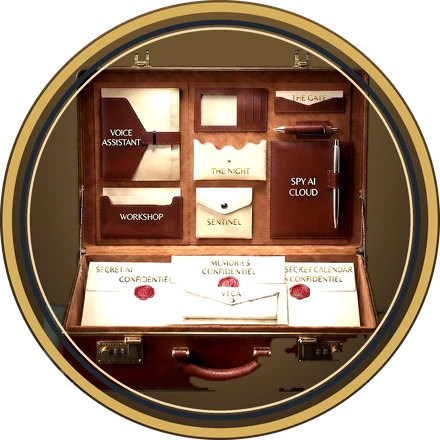
Beyond the encrypted storage layer, a house of specialized local agents runs with Ollama — all of them live in the lab build — each with a distinct role and its own moment of the day. The architecture is lightweight by design — each agent does one job, and one job only.
Scores every new piece of information across four axes: priority, emotional weight, valence (positive or negative), and intended duration. Generates a unique emotional personal signature.
Maintains a compressed raw log of everything that happens. Full history with fast search — the complete record that can be queried when needed.
Detects sensitive information — banking credentials, passwords, personal identifiers — and routes it directly into a separate encrypted vault.
Evaluates risk based on your personal criteria — a 50-question questionnaire you fill and edit, kept encrypted like everything else. Not a fixed corporate list. Your own definition of "sensitive".
Runs while you sleep. Deduplicates, strengthens frequently-accessed memories, lets old ones fade naturally, and builds connections between related events.
Three more agents have since joined the house, born in the lab: the Gatekeeper (the exit door — nothing leaves without an exact preview and your explicit yes), Columbo (compares what cloud AIs claim against your memories, the only ground truth about you, and flags the exact contradicted sentence — judged locally), and Pénélope (the self-model weaver: at most three cards a night — always a question, never advice — one tap answers each). The full agent house is described on the Memory page.
A neuroscience-inspired design layer — all five mechanisms now run in the lab build — published June 2026 on the Memory page, extends the agents: surprise scoring (prediction-error boosts priority), episodic→semantic distillation (nightly facts with provenance links back to source days), a local interrogation log of every external AI query, canary memories (deliberately left unexplained), and explicit recall confirmation for the vault.
Every mechanism runs on the user's machine. Sanctum Elysium operates no server holding user memory — "cloud" in this document always refers to external AI providers, never Sanctum Elysium.
$LOAM Tokenomics
$LOAM is a Solana SPL Token-2022 token with a permanently fixed supply of 10,000,000 units. The mint authority was revoked at launch — no additional tokens can ever be created. Every allocation, every unlock date, and every wallet address is public and verifiable on-chain.
Every $LOAM transaction — each buy, each sell, and each wallet-to-wallet transfer — incurs a 3% fee. This is a 3% transfer fee enforced at the protocol level by the SPL Token-2022 transfer-fee extension — its fee-config authority is revoked, so the 3% rate is locked forever and can never be raised; fees are withheld on every transfer and periodically withdrawn to the FEES wallet (2JCUwo9h7Qh132qgG7vUN2owjjFqzZCF7GnL7aYPHkMb, the mint's withdraw-withheld-authority), then distributed monthly. A single, uniform rate keeps the monthly dashboard redistribution simple and predictable. The fee is split monthly:
Holder community redistributions are sent directly to the holding wallet monthly — no claim required. Eligibility (30+ days held and at least 1 $LOAM in the wallet) is measured on the last day of each month and paid on the 14th of the following month; the patience score itself accrues from day 1. Like every $LOAM transfer, the payout transfers themselves incur the protocol-level 3% fee — amounts received are net of it. No lock — hold or exit on your own schedule. A variable rate (0.05–1.25%, set by the $LOAM market cap tier) is applied to the LAND Fund's $LOAM balance and swapped for Bitcoin monthly. This is a community redistribution, not a dividend — no profit is promised or expected.
Every holder accumulates a ◆ Patience Score silently, every day they hold. No action required. The formula:
One bonus on top: wallets that have never sold a single token keep a permanent 1.25× multiplier on their score — a thank-you to true diamond hands. Sell even once, even a single token, and the multiplier is gone for good for that wallet (your base score still grows normally on whatever you hold). The badge lives per wallet, and the chain cannot tell a wallet-to-wallet transfer from an off-market sale — so a transfer counts as a sale for the sending wallet, while the receiving wallet starts fresh: score at zero, diamond intact until it sells.
The patience score determines two things: (1) your proportional share of the 1.25% monthly community redistribution — computed among eligible wallets (30+ days held and at least 1 $LOAM) — and (2) your share of the LAND Fund redemption (April 13, 2029). Redemption shares are frozen on a single snapshot of the patience ledger taken when the window opens — sending your $LOAM to the fund to redeem never reduces your recorded share, nor anyone else's. A holder with 1,000 $LOAM for 365 days outscores a holder with 10,000 $LOAM for 30 days. The patience score is a participation metric — not an ownership or profit stake. No yield, dividend, or profit is promised.
Treasury wallets are held in cold, air-gapped storage; FEES, PROJECT and the LAND FUND OPS wallet are operational wallets used for the monthly fee distribution and BTC conversions. The addresses are public and verifiable on-chain at any time via Solana Explorer.
| Wallet | Address | Amount | Unlock | Verify |
|---|---|---|---|---|
| 💧 LIQUIDITY | 3Dak…buEE |
4.0M $LOAM | Raydium Pool seeded at launch |
↗ Solana Explorer |
| 🛠️ COMMUNITY | 7wBZ…8Dad |
500K $LOAM | Nov 30, 2026 | ↗ Solana Explorer |
| 🏡 LANDFUND VAULT | 2Bzh…kuhb |
5.0M $LOAM | April 2029 | ↗ Solana Explorer |
| 🌱 LANDFUND OPS | D8N4…7Xgf |
Working capital | Monthly ops 1.25% in · BTC out |
↗ Solana Explorer |
| 👤 FOUNDER | 9EYR…DUCA |
500K $LOAM | June 2031 5-yr vesting · 1-yr cliff |
↗ Solana Explorer |
| 👤 FOUNDER FEES | G9mW…ZR1R |
Accumulates 0.25% | June 2031 same 5-yr vesting |
↗ Solana Explorer |
| 💰 FEES | 2JCU…PHkMb |
Accumulates | Monthly dist. | ↗ Solana Explorer |
| ⚙️ PROJECT | Dhim…TPwha |
Receives 0.25% | Monthly dist. | ↗ Solana Explorer |
LAND Fund
The LAND Fund is the physical backbone of Sanctum Elysium. Half the token supply exists for one purpose: build the Bitcoin reserve that lets holders acquire land parcels, solar equipment, and farm assets — negotiated as a group, owned individually. Every transaction adds 1.25% of its value as $LOAM to the LAND Fund balance. Separately, each month, a variable rate (0.05–1.25%, set by the market cap tier) is applied to that accumulated $LOAM balance and swapped for Bitcoin. From April 13, 2029, holders redeem their $LOAM for their share of that Bitcoin reserve — two paths, land or gear, detailed in §5.3 — with no sell pressure on the market.
Two streams build the LAND Fund's $LOAM balance: 5,000,000 $LOAM (50% of total supply) allocated at launch, plus 1.25% of every transaction collected as $LOAM and added to the balance permanently — forever, for every holder who joins. Separately, each month, a variable rate — set by the market cap tier — is applied to the LAND Fund's total $LOAM balance and swapped to Bitcoin. This reduces the LOAM balance and builds the BTC reserve. The rate protects the price floor when the market is fragile and maximizes BTC accumulation when the token is strong. Bitcoin accumulates until the redemption window opens on Friday, April 13, 2029, at 21:46 UTC. No physical asset is acquired before that date. When the window opens, holders redeem their $LOAM for their share of the Bitcoin reserve according to their patience score (tokens × days held, ×1.25 if never sold anything).
| Market Cap | ⟳ Monthly Rate | Why |
|---|---|---|
| Below $10K | 0.05% | Price discovery — protect floor |
| $10K – $50K | 0.15% | Early stage |
| $50K – $250K | 0.30% | Emerging traction |
| $250K – $1M | 0.50% | Standard rate |
| $1M – $5M | 0.75% | Established |
| $5M – $20M | 1.00% | Confirmed success |
| Above $20M | 1.25% | Exceptional |
The rate is set by the $LOAM market cap tier — the average of the month's three highest market caps — then applied to the LAND Fund's total $LOAM balance. Published publicly before each conversion.
The fund has three permitted use categories. Each holder chooses their preference independently based on their personal situation and needs:
Direct land acquisition — individual parcel, negotiated as a group for better pricing and conditions. Priority use of the fund.
☀️Energy independence kit. Solar panels, battery storage, inverter. Powers your home, your tools, your local AI — without the grid.
🌾Seeds, tools, equipment, irrigation infrastructure. The foundation of food sovereignty on your own land.
Starting April 13, 2029, holders send their $LOAM directly to the LAND Fund wallet — not to a DEX, not to the market. In return, they receive their proportional share of the Bitcoin accumulated, based on their patience score (tokens × days held, ×1.25 if you've never sold a single token). For land, your share is transferred to your wallet — you pay the seller directly and the title lands in your name; in the early days, Sanctum Elysium mediates the deal automatically between you and the seller, to cover the big risks and guide a fair price. For solar, batteries and equipment, a vote gathers everyone who wants the same product from the same supplier — Sanctum Elysium places one bulk order and pays the supplier in BTC (that is what unlocks the volume discount, which can reach 20–30%), then the gear is shipped to each holder. Yours, entirely. Redemption is a voluntary community mechanic, not a financial return or a guaranteed entitlement.
The $LOAM returned to the fund does not hit the open market. The circulating supply contracts. Remaining holders benefit. Those who waited longest exit with the largest share — free to plant it into real land, solar panels, batteries, or farm equipment. No one is told what to do with their share; when the whole group unlocks the same prices, roots simply become the obvious choice. Always free. Organically aligned.
→ Why selling never hurts long-term holders — the equilibrium explained
Community negotiation amplifies the outcome. A single buyer negotiating alone has no leverage. Sanctum Elysium negotiates as a group: bulk pricing, preferred supplier relationships, and conditions unavailable to individuals. It is a negotiator, not a landlord — it never takes title, and the land ends up in your name. → The Buyers' Table — the full structure
Roadmap — 2026 → 2031
Six milestones define the $LOAM lifecycle — from genesis to full vesting. The dot below updates in real time, showing exactly where the project stands today.
$LOAM
Community
Accumulates
Cliff Ends
Fund
Fully Vested
Phase 1 — Genesis (2026): $LOAM launched on Solana (June 25, 2026). The initial liquidity pool lives on Raydium, seeded with 4.0M tokens (40% of supply). Transaction fees begin accumulating. The first monthly BTC conversion applies based on the market cap tier (starting at 0.05%). A public holder dashboard 📊 goes live — every wallet's patience score and exact LAND Fund share, fully transparent and verifiable.
Phase 2 — Community & Builders (Late 2026): The 500K Community & Builders allocation (5%) becomes claimable — distributed to the earliest serious supporters and contributors.
Phase 3 — Accumulation (2026-2029): Two flows run in parallel. Inbound: 1.25% of every transaction is collected as $LOAM and added to the LAND Fund balance. Outbound: each month, a variable rate — set by the market cap tier — is applied to the LAND Fund's total $LOAM balance and swapped to Bitcoin. Patience scores build silently. The memory track (§6.2) runs in parallel.
Phase 4 — Redemption Opens (April 13, 2029): The redemption window opens. Holders exchange $LOAM for their share of the Bitcoin reserve, based on their patience score, through the two paths detailed in §5.3 — land (BTC to your wallet, title in your name) or gear (one bulk order, volume pricing). No sell pressure. Sanctum Elysium negotiates as a group — and never takes title. A voluntary community mechanic — not a financial return, and not guaranteed.
Phase 5 — Founder Vesting Complete (June 2031): The founder's 5% allocation (500K $LOAM) finishes vesting. The schedule is the longest lock in the project: a 12-month cliff first — nothing unlocks before June 2027 — then the 500K release in equal monthly amounts over the following 48 months, fully vested in June 2031. The founder waits longest of anyone.
The token calendar above funds the work; the memory — the technical core — follows its own track. Interface demo (July 2026 — delivered): the first public look at the working interface — shown, pocket by pocket, on The Interface. Private testing (August 2026), then open beta (September–October): the first builds to leave the lab — a month of private testing and tuning by the founder first, then the open beta for everyone — two distinct milestones: first you watch it work, then you run it yourself. Hardware lab (November–December 2026): planned acquisition of a dedicated air-gapped rig (Nvidia Jetson Orin NX class, ~$900) to prove the full system runs offline on affordable hardware. The system will be open-source and free for everyone (§3); the living status of every line item is tracked on the Build Status page.
Patience is the only requirement. The calendar is the contract.
Governance
Sanctum Elysium has formalized its governance layer: The Vote — a Patience-Score-weighted, non-binding community signal signed with a Solana wallet (an ed25519 message signature, e.g. Phantom's signMessage).
How it works: holders sign preferences off-chain using their wallet's signMessage — a structured plain-text payload (domain, proposal id, choice, voter pubkey, timestamp) following the Sign-In-With-Solana (SIWS) convention, no transaction, no gas, no on-chain footprint. A signed message is just data: it cannot move, lock, or access the holder's $LOAM (it carries no token instruction). Solana message-signing doesn't enforce a domain separator at the protocol level, so the domain field is added to the payload to get that anti-phishing, anti-replay binding. Weight is Patience-Score-based, read at an announced snapshot slot: tokens × days held, ×1.25 permanent multiplier for wallets that have never sold. After the close, signatures and the balance/holding-age snapshot are published so anyone can re-verify the tally. When a choice is ready to finalize, a short signed snapshot locks it in.
This is explicitly not shareholder voting, not a financial right, not a legal claim over any entity. It is a community preference signal — the project uses it as input, not mandate. Preferences are standing signals, editable anytime. Not zero-sum: backing "land" is not a vote against "solar." Each holder's share funds their own homestead, and a holder can back multiple categories at once.
Open questions are numbered and dated (registry reordered 2026-06-10 — rules-type questions lead, the mandatory ranking anchors the list): (01, added 2026-06-08) Early redemption trigger — if market cap exceeds a holder-set threshold before April 13, 2029, holders set the trigger cap and how far to advance the date; (02, added 2026-06-10) Conversion-rate tiers — whether to add new tiers above the current "over $20M → 1.25%" top of the BTC conversion table; (03, added 2026-06-10) Monthly conversion execution — one block on the last day, or spread in smaller tranches (daily/weekly DCA) across the month — the amount never changes, only the style; (04, added 2026-06-08, reframed 2026-06-10) What We Buy — Your Priority Order — a mandatory ranked ballot: every holder ranks the four categories (land, energy, garden & food, animals) 1→4, and the aggregated patience-weighted ranking becomes the Fund's budget split per category. Year 2 brings the supplier picks, starting with the solar-panel supplier (drafting as SE-05). More questions will be added over time.
Security Decision — Why No On-Chain Freeze?
There is no custom smart contract to attack. $LOAM does not deploy bespoke code: it is a standard token minted with the audited, widely-deployed SPL Token-2022 program. The only configuration is the transfer-fee extension (the 3% fee) and its withdraw-withheld-authority — both public and verifiable on-chain. Three on-chain facts tell the whole story: the mint authority is revoked (the 10M supply can never grow), the transfer-fee-config authority is revoked (the 3% can never be raised), and no freeze authority exists (no one can ever freeze a holder's tokens). There is no vesting contract, no upgradeable logic that an exploit could target.
An early idea called for custom on-chain freezing of the Community and LAND Fund wallets — locked automatically, trustless by design. This was rejected after careful consideration of the AI threat landscape. AI capability is advancing exponentially. State-of-the-art systems can already read, reason about, and probe smart-contract code at machine speed — and the attack surface on custom on-chain logic, freeze and vesting code included, will keep expanding in ways that cannot be fully predicted today. An AI-assisted exploit targeting a locked community wallet would be permanent and unrecoverable. Relying on a single, battle-tested program and nothing more is the safer posture.
The Community, LAND Fund, and Founder wallets are held in cold, air-gapped storage — secured to the highest standard achievable. They will not move before their respective release dates. Every address is public, on-chain, and independently verifiable by anyone at any time. That is the commitment.
No custom code to audit — just a well-known program and published configuration. Transparency — not bespoke code — is the guarantee.
Risk Factors
$LOAM is a small community token at an early stage. Volatility is high and the risk of total loss is real. Do not allocate funds you cannot afford to lose entirely. This document is not investment advice.
Market Risk: $LOAM may trade at zero at any time. There is no floor, no buyback mechanism, and no guarantee of liquidity. Token price reflects community conviction, not underlying asset value.
Execution Risk: The memory system, the LAND Fund acquisition process, and the governance structure are all in development. Timelines may shift. Features may change. The project is built by a small team with limited resources.
Regulatory Risk: Cryptocurrency regulation is evolving rapidly across all jurisdictions. Changes in law may affect the ability to hold, transfer, or redeem $LOAM.
Custody Risk: Wallets are held in cold storage. Loss of private keys — through accident, death, or coercion — would result in permanent loss of those funds.
Key-Person Risk: Monthly conversions, fee distributions, and the 2029 redemption are executed manually by a single anonymous founder — a deliberate consequence of the no-custom-code posture (§8): nothing on-chain can be exploited, but nothing on-chain runs by itself either. The mitigations are procedural, not technical: published wallets, published dates, and a public record that makes any deviation visible immediately.
Legal
$LOAM is a meme coin. It is not offered as an investment, a security, or an equity stake in any company or organization. It has no legal claim on any assets, no governance rights over any legal entity, and no redemption guarantee. The memory software will be open-source and free for everyone — $LOAM gates nothing inside it.
Sanctum Elysium is not a registered company. There are no officers, directors, or shareholders. The founder operates anonymously by choice. There is no legal recourse available to holders.
The LAND Fund's acquisition activity — when it commences in 2029 — will be conducted transparently and publicly. No legal structure for that process exists yet; it will be designed and communicated before the unlock date.
Purchasing $LOAM constitutes acknowledgment that nothing is promised, nothing is guaranteed, and the only binding commitment is the one written in the public record of this site and the Solana blockchain.
This is a pure community token. Buy only what you can afford to lose. Stay free.
On-Chain Addresses
All addresses listed below are permanent and verifiable on the Solana blockchain via Solana Explorer.
9K2woKwE4t5PEVM26enVMk2ubfMvYQwTJjrNsBfrnDXP
Never touched crypto? How to Buy walks you from a normal bank account to your first $LOAM — the app for your region, your own wallet, the swap. Always copy-paste this address, never type it.
bc1q3w9lv95wk3dtvc2wmhvkjexr5rnpqd7purmgaq
The monthly BTC conversions accumulate here until redemption. This is the only official reserve address — any other Bitcoin address claiming to be the Sanctum Elysium reserve is fake.
| Wallet | Full Address | Amount | Unlock | Verify |
|---|---|---|---|---|
| 💧 LIQUIDITY | 3Dakd2Sqg84E16qdAK9qSH6r6iGrCTDgg5u5RvUSbuEE |
4.0M $LOAM | Raydium Pool | ↗ Solana Explorer |
| 🛠️ COMMUNITY | 7wBZEvzjz4vyMyBqRhvXP71A8vma4gUcfKZZvtDk8Dad |
500K $LOAM | Nov 30, 2026 | ↗ Solana Explorer |
| 🏡 LANDFUND VAULT | 2BzhEuCFL4GKtuvtoHpFZp4kCbS8EN4eFpCJtyEUkuhb |
5.0M $LOAM | April 2029 | ↗ Solana Explorer |
| 🌱 LANDFUND OPS | D8N4gdTgo7R2PRv2qYZg144gutgRg6XnjF91MoAn7Xgf |
Working capital | Monthly ops | ↗ Solana Explorer |
| 👤 FOUNDER | 9EYR9H85pum2wWipazDPpjGN4Nw6VirUD7km2X9xDUCA |
500K $LOAM | June 2031 5-yr vesting · 1-yr cliff |
↗ Solana Explorer |
| 👤 FOUNDER FEES | G9mWVrZJdqyPf2PuAGQ4bcZ442rt8vKCggRxM4rXZR1R |
Accumulates 0.25% | June 2031 same 5-yr vesting |
↗ Solana Explorer |
| 💰 FEES | 2JCUwo9h7Qh132qgG7vUN2owjjFqzZCF7GnL7aYPHkMb |
Accumulates | Monthly dist. | ↗ Solana Explorer |
| ⚙️ PROJECT | DhimLysS8Jc3u6ov45fN9Gwzcg8E6qMZiojSF84TPwha |
Receives 0.25% | Monthly dist. | ↗ Solana Explorer |
Website: sanctumelysium.com · 𝕏: @LOAM_token · Token mint: the address above. There is no official Telegram and no other channel — anything else claiming to speak for Sanctum Elysium is fake. No one from the project will ever DM you first or ask for your seed phrase.
v1.0 — June 2026. First edition, published at launch.
v1.1 — July 2026. Memory track added to the roadmap (§6.2); the free & open-source commitment stated (§0, §3, §10); authority revocations spelled out (§4.2, §8); Bitcoin reserve address and official channels published (Appendix); key-person risk added (§9); §1 statistics sourced; wording tightened throughout.
v1.2 — July 2026. Interface demo delivered — the Memory Track (§6.2) now links the demo page, The Interface (memory-interface.html).
v1.3 — July 2026. PROJECT fee wallet published — the 0.25% project-expenses share of the monthly distribution now has its own public address (§4.4, Appendix).
v1.4 — August 2026. Fixed payout day — the monthly holder redistribution now pays on the 14th of the following month (§4.3), inside the original 15-day window. Treasury hardening — the LAND Fund's 5,000,000 now sit in a cold vault generated offline that has never signed a transaction (2Bzh…kuhb), while a small ops wallet (D8N4…7Xgf) receives the monthly fee share and executes the BTC conversions; COMMUNITY, FOUNDER, FOUNDER FEES and The Game moved to fresh cold wallets the same day.
v1.5 — October 2026. Minimum balance — a wallet must also hold at least 1 $LOAM at the end-of-month snapshot to take part in the monthly holder redistribution (§4.2, §4.3); wallets under 1 token stay listed and keep accruing score, and the pool is split among the remaining eligible wallets. First measured on the October 31, 2026 snapshot (payout of November 14, 2026). The 2029 redemption share is unchanged.
Sanctum Elysium is not a product. It is a direction. A bet that sovereignty — digital and physical — is worth building for, even when the outcome is uncertain.
Every holder is a co-builder. Every idea that proves sound becomes part of the record. The Sanctum is young. The work has begun.
Patience is land. Land is freedom.
— forever.
 The Memory